
Impatiens hawkeri, commonly called New Guinea impatiens, is a warm-loving perennial from the rainforests of New Guinea, widely grown as a bedding and container plant in temperate regions. It forms a bushy, mound-like habit with fleshy stems and glossy, lanceolate leaves that may be deep green, bronze, or variegated. Large, five-petaled flowers in vivid shades of red, pink, orange, lavender, and white are produced continuously under good light, and the plants are largely self-cleaning. Compared with I. walleriana, New Guinea types have bigger flowers, thicker foliage, and better heat and sun tolerance when kept evenly moist. They prefer well-drained, organic-rich media and consistent moisture without waterlogging. In frost-free climates they are perennial; elsewhere they are treated as annuals or overwintered indoors. They are generally pest-resistant with good cultural care but may attract thrips or spider mites in dry, warm conditions.
Archives: Plants
-
Wild radish
Raphanus raphanistrum, commonly called wild radish, is a hardy annual or short-lived biennial in the mustard family (Brassicaceae), native to the Mediterranean but now naturalized on most continents. It forms a basal rosette of rough, pinnately lobed leaves with bristly hairs, and erect, branched stems 20–80 cm tall. Showy four-petaled flowers range from creamy white to pale yellow or lilac with purple veins, followed by unmistakable jointed, beaded seed pods (siliques) that break into segments when ripe. Blooming peaks in cool seasons, and flowers attract bees and other pollinators. The species thrives in disturbed soils—field margins, pastures, roadsides, and coastal dunes—and tolerates wind, sandy soils, and light salt spray. While young leaves and pods are edible and peppery, the seeds and mature plants can be harmful to livestock if consumed in quantity. It self-seeds readily and can become invasive if not managed. Deep taproots confer drought resilience, and the plant adapts to a wide range of soils from sandy to loamy, slightly acidic to neutral.
-
Krantz aloe
Aloe arborescens is a fast-growing, shrubby aloe prized for architectural form, winter bloom, and durability. It develops a multi-stemmed, candelabra-like habit to 2–3 meters tall and wide, with rosettes of narrow, recurved, gray-green leaves edged with small, sharp teeth. In cool seasons (often mid-winter), it produces showy, upright to slightly conical racemes of tubular flowers—typically fiery orange-red, with yellow forms also known—rich in nectar and beloved by sunbirds, hummingbirds, and pollinators. Naturally adapted to rocky slopes and coastal cliffs, it tolerates wind, salt spray, and drought once established. The plant forms clumps by offsetting, making it excellent for living hedges and erosion control. Although related to Aloe vera, its sap chemistry differs; the inner gel is traditionally used topically in some cultures, while the bitter latex can irritate if ingested. Indoors, it brings bold texture and thrives in bright light; outdoors, it excels in Mediterranean, subtropical, and frost-free temperate climates with well-drained, gritty soils.
-
Creeping buttercup
Ranunculus repens, commonly called creeping buttercup, is a stoloniferous perennial in the buttercup family (Ranunculaceae). Native to Europe and parts of Western Asia and North Africa, it is now widely naturalized throughout temperate regions. It spreads by runners that root at nodes, forming dense mats in moist, heavy, or compacted soils. Leaves are glossy, trifoliate, and often mottled with pale patches; stems are low and sprawling. From spring into early summer, it bears numerous bright, lacquer-yellow, five-petaled flowers about 2–3 cm across that attract early-season pollinators. While occasionally used in rain gardens or naturalized areas, it is regarded as a weed or invasive species in many regions due to its aggressive spread. All fresh parts contain the irritant protoanemonin; sap can blister skin, and ingestion causes gastrointestinal upset in humans and livestock. It is distinguishable from tall buttercup (R. acris) by its creeping habit and rooting stolons.
-
Glossy abelia
Abelia × grandiflora (glossy abelia) is a semi-evergreen to evergreen hybrid shrub valued for its long bloom season, graceful arching habit, and glossy foliage. A cross between Abelia chinensis and A. uniflora, it forms a dense mound with reddish new growth maturing to deep green, often taking on bronze or purple tints in cool weather. From late spring or early summer into fall, it bears abundant small, fragrant, tubular flowers—white flushed with pink—followed by persistent, colorful calyces that extend ornamental interest. Typically 4–6 ft (1.2–1.8 m) tall and wide, it’s adaptable, heat-tolerant, and relatively pest-free, attracting bees, butterflies, and other pollinators. It responds well to pruning and is commonly used as a foundation shrub, informal hedge, or mass planting. In colder climates it may experience dieback but usually regrows from the base. Numerous cultivars offer compact habits or variegated foliage.
-
Pontic rhododendron
Rhododendron ponticum is a broadleaf evergreen shrub prized for its trusses of funnel-shaped mauve to purple flowers that appear in late spring to early summer. Native to parts of the Iberian Peninsula and the Black Sea–Caucasus region, it forms dense thickets 2–6 m tall with leathery, lanceolate, dark green leaves. It thrives on acidic, humus-rich, consistently moist but well-drained soils and has a shallow, fibrous root system that benefits greatly from organic mulch. In cool, maritime climates it tolerates more sun; elsewhere it prefers dappled shade and shelter from drying winds. The species reproduces easily by seed and layering, enabling it to dominate understories in suitable habitats; it is considered highly invasive in parts of western and northern Europe, notably the British Isles. All parts contain grayanotoxins, making the plant poisonous to humans and animals; nectar can yield “mad honey.” In cultivation it can be an effective screening shrub, but management is essential to prevent unwanted spread and to maintain soil acidity and moisture levels that support healthy growth and flowering.
-
New Zealand broadleaf
Griselinia littoralis is a versatile evergreen shrub or small tree native to New Zealand’s coastal and lowland forests. It forms dense, upright screens with glossy, apple-green, leathery leaves arranged opposite on sturdy stems. In the landscape it typically reaches 2–5 m as a hedge, but can exceed this in mild climates if unpruned. The species is dioecious: inconspicuous greenish flowers appear in spring on separate male and female plants, followed by small purple-black berries on female plants that attract birds. Highly tolerant of salt-laden winds and exposure, it thrives in coastal settings and urban gardens alike. Growth is moderate to fast in fertile, free-draining soils ranging from slightly acidic to neutral. It responds exceptionally well to trimming, making it a popular choice for formal hedges and shelterbelts. Once established, it is notably drought-tolerant, yet it dislikes waterlogged conditions. With regular pruning and mulching, it maintains a tight, lush habit and rich color year-round.
-
Fish mint
Houttuynia cordata is a rhizomatous, cold-hardy perennial native to East and Southeast Asia. It forms dense mats of heart-shaped leaves, 3–8 cm wide, that release a distinctive fishy aroma when bruised. In late spring to summer it produces small, yellowish flower spikes surrounded by four showy white bracts. Plants typically reach 20–60 cm tall and spread rapidly via creeping underground rhizomes. The popular variegated cultivar ‘Chameleon’ displays splashes of green, cream, and red. Houttuynia thrives in consistently moist to wet soils along streams, pond margins, and damp woodland edges, and it is often used as a marginal aquatic or groundcover in shade gardens. The foliage and roots are edible and used as an herb in Vietnamese, Chinese, and Japanese cuisines and traditional medicine. Because it spreads aggressively and can become invasive where hardy, it is best confined to containers or beds with barriers, especially near natural areas. Aboveground growth dies back in winter and re-sprouts vigorously in spring.
-
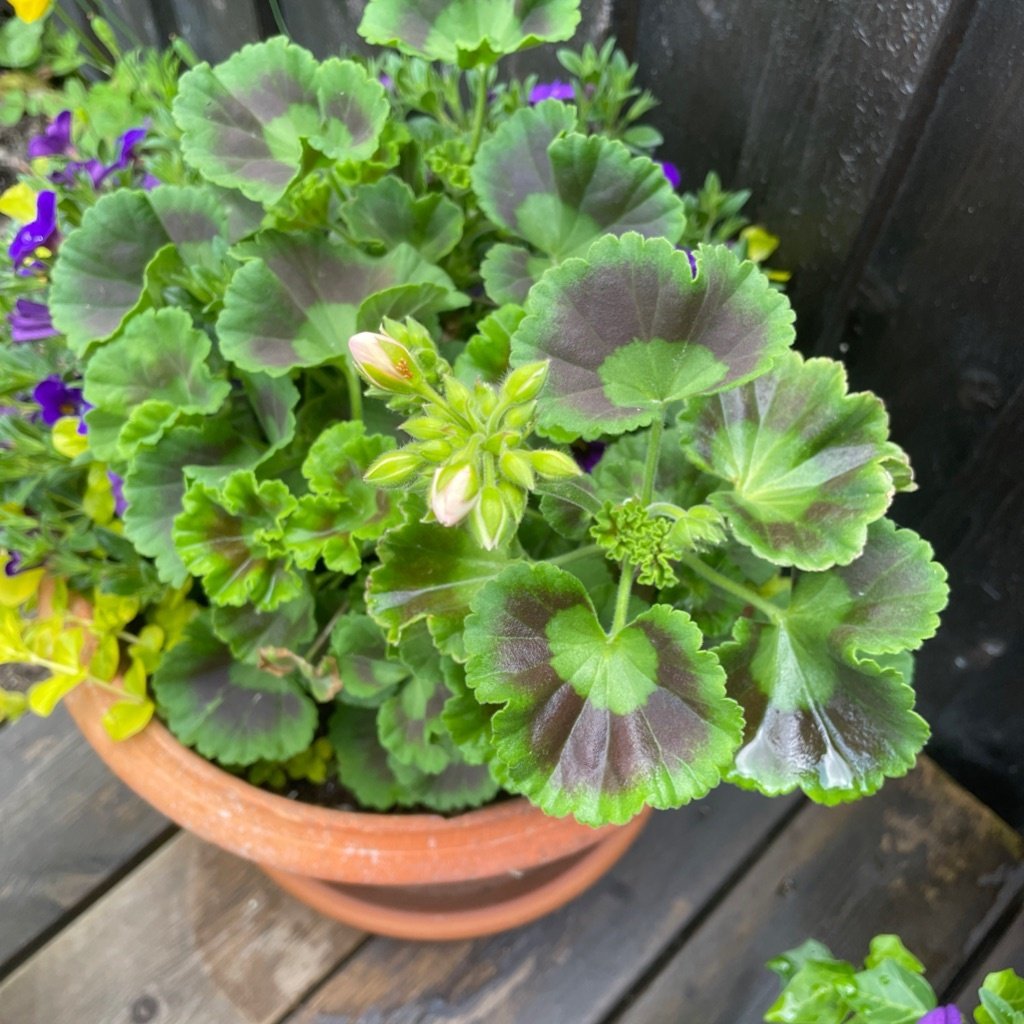
Zonal geranium
Pelargonium zonale, commonly called the zonal geranium, is a tender, evergreen subshrub native to southern Africa and the main parent of countless bedding geranium cultivars. It forms sturdy, semi-succulent stems clothed in rounded, softly pubescent leaves marked by a distinctive dark “zone” or horseshoe band. Umbels of showy single or double flowers in red, pink, salmon, white, or bi-color appear over a long season in warm, bright conditions. In containers or borders it stays compact with regular pinching, and performs best in airy, sharply drained media. Though drought-tolerant once established, it flowers most freely with moderate, consistent moisture and balanced feeding. Not frost-hardy, it is grown as a seasonal annual in cold climates or overwintered indoors in bright, cool, ventilated quarters. Common issues include Botrytis gray mold, bacterial blight, edema from overwatering, and rust (Puccinia pelargonii-zonalis), especially in high humidity and stagnant air. Plants propagate readily from stem cuttings; seeds possess a feathery awn that twists into crevices. Lightly aromatic foliage and nectar-rich blooms attract bees and butterflies.
-
Treasure Flower
Gazania rigens, commonly called treasure flower, is a sun-loving, low-growing perennial often treated as an annual in cooler climates. Native to southern Africa, it forms neat rosettes or spreading mats of lobed, lanceolate leaves that are green above and silvery-tomentose beneath, helping the plant conserve moisture and reflect heat. Its daisy-like inflorescences display bold ray florets in vivid oranges, yellows, reds, pinks, and bicolors with striking banding, surrounding a golden disk. Flowers typically open only in bright sunlight and close at night or on cloudy days. Highly drought tolerant, Gazania thrives in sandy, sharply drained soils where many ornamentals struggle. It is widely used for edging, rock gardens, coastal plantings, median strips, and containers. Plants grow about 15–30 cm tall and 30–60 cm wide, blooming prolifically from late spring through fall in warm regions. Gazania rigens attracts pollinators, tolerates wind and salt spray, and excels in heat, but it is sensitive to prolonged frost and overly rich or wet soils, which reduce flowering and cause crown rot.
